
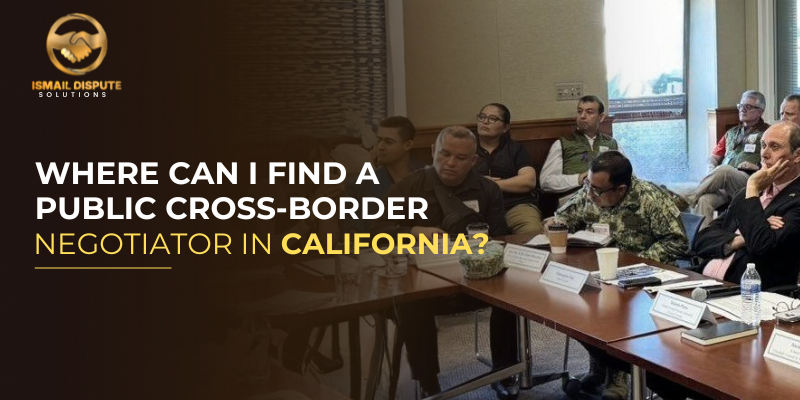
When a government body, city, or public agency faces a dispute with a foreign entity, it needs someone who understands negotiation across borders and different government structures. Taking an international dispute through formal proceedings can be time-consuming and expensive for public entities. You need a professional who understands the different political, cultural, and organizational factors involved. A California-based negotiator helps public entities solve global conflicts quietly, keeping the dispute out of the press and out of the courtroom.
Table of Contents
- Should we hire a specialized negotiator instead of pursuing international tribunal litigation?
- What international credentials should I look for in a cross-border public negotiator?
- How does Ismail Dispute Solutions help protect our public entity’s reputation during negotiations?
Should we hire a specialized negotiator instead of pursuing international tribunal litigation?
Hiring a California public cross-border negotiator can help your agency explore a negotiated solution before committing to lengthy and expensive formal proceedings. Ismail Dispute Solutions helps public entities work toward private resolutions to international disputes, potentially avoiding lengthy formal proceedings.
| Feature | Cross-Border Negotiation | International Tribunal |
| Final Control | You and the other party agree on the exact terms. | A foreign judge or panel takes a decision for you. |
| Public Exposure | Talks happen behind closed doors and remain private. | Court filings and arguments may become public record. |
| Time to Resolve | Most deals close in three to six months. | Cases usually drag on for one to two years. |
What international credentials should I look for in a cross-border public negotiator?
Find someone that understands government structures and has negotiating experience. Ismail Dispute Solutions is all about the practical know-how to conduct cross-border discussions.
- International Trade Awareness – The negotiator understands relevant trade agreements and international business practices that may impact the negotiation.
- Cross-Border Issues Understanding – They consider how varying governmental priorities, policies and local conditions may impact the dispute.
- Cross-cultural Navigation – they bridge the gap between English speaking cultures (US, Southern American, European and Asian cultures)
How does Ismail Dispute Solutions help to preserve the reputation of our public entity through negotiations?
Ismail Dispute Solutions assists public bodies to engage in confidential, cross-border discussions, with an emphasis on confidentiality and reputation. We act as a buffer between the foreign opposing entity and your public officials.
- Confidential Discussions – We set clear expectations around confidentiality ahead of discussions commencing.
- Coordinated Public Messaging – We help both sides coordinate public messaging, where appropriate, to ensure a consistent message and to reduce confusion.
- Assist Public Officials – We help keep discussions focused and productive so public officials can concentrate on their work and relations with international partners.
(Also read: Stop “Winning” the Argument: The Difference Between Bullying and Negotiating)
Let’s Resolve Your International Dispute
Handling a conflict across borders requires an understanding of different cultures, priorities, and communication styles. Contact Ismail Dispute Solutions to discuss a practical, confidential approach to your international dispute. Start the Resolution Process.
FAQs
How long does cross-border negotiation actually take?
Most public cross-border disputes reach a settled agreement in three to six months. The timeline depends heavily on the complexity of the case.
Where do the negotiation meetings take place?
We hold meetings virtually through secure networks, at neutral third-party sites or directly in California offices to make sure there’s total privacy.
Can a negotiated agreement help resolve a cross-border dispute?
A negotiated agreement can help both parties establish clear expectations and an agreement of next steps. The outcome depends on the terms agreed upon and the circumstances of the dispute.